
Governors — Flyweights, Hydraulics & Dead Band
How centrifugal force versus a spring holds engine speed — and the deliberate silence that stops the hunting.
Key Principles at a Glance 6 points
- No operator can match propeller load swing for swing — the governor measures speed and moves the fuel rack continuously.
- Every governor does two jobs: sense speed (flyweights, hydraulics or electronics) and stroke the fuel control shaft.
- Mechanical logic is a force fight: load-up lets the speeder spring win and fuel rises; load-down lets centrifugal force win and fuel falls.
- Hydraulics add muscle plus manners: power piston moves the rack while buffer springs and a needle-valve timer prevent hunting.
- Electronics drop the linkages entirely — DC/AC signals measure and command with the accuracy linkages cannot reach.
- Dead band is the no-action band around set point (78° vs set point leaves 2° ignored) — too wide kills sensitivity, too narrow hunts forever.
1. Measure, Then Move
Propulsion load never sits still, and no human trims fuel fast or fine enough to hold revs against it. The governor closes the loop instead: sense speed (spinning flyweights, oil pressures or electronic pickups), compare against the speeder-spring setting, stroke the fuel-rack shaft to correct. Three families implement it — mechanical linkages direct from flyweights, hydraulic relays amplifying them with external oil power, electronic signals with no moving linkage at all and the finest control.
2. Mechanical — Spring vs Spin
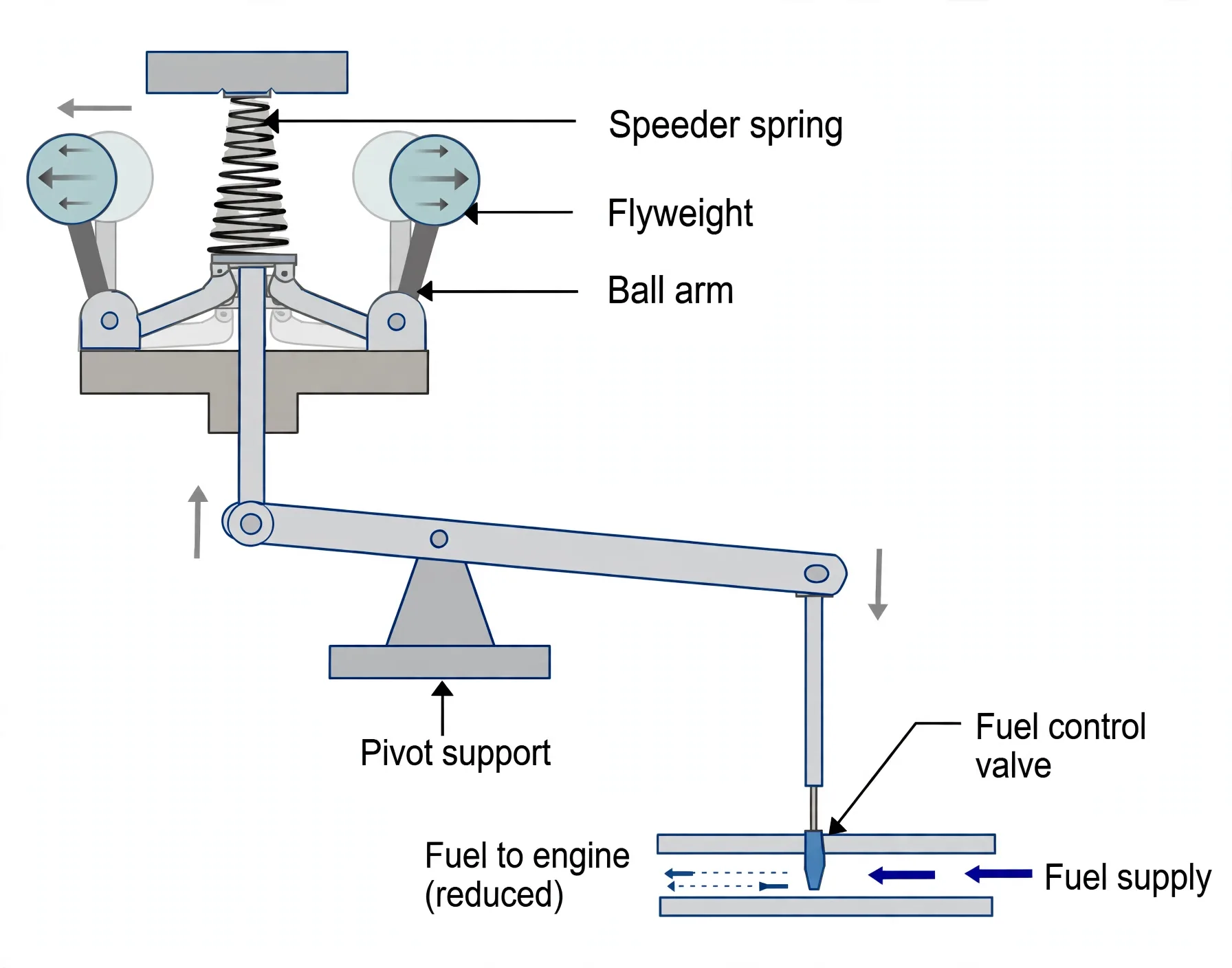
Twin flyweights on a driven ball-head fling outward with speed against the speeder spring, working a pivoted linkage to the fuel rod. Load up, revs sag: spin weakens, spring wins, weights tuck in, sleeve drops, linkage lifts — more fuel until set speed returns. Load off, revs climb: spin strengthens, weights fly out, sleeve rises, linkage bears down — less fuel until governed speed restores. Friction-overcoming force both ways, direction flipping with the load.
3. Hydraulic — Muscle With Manners
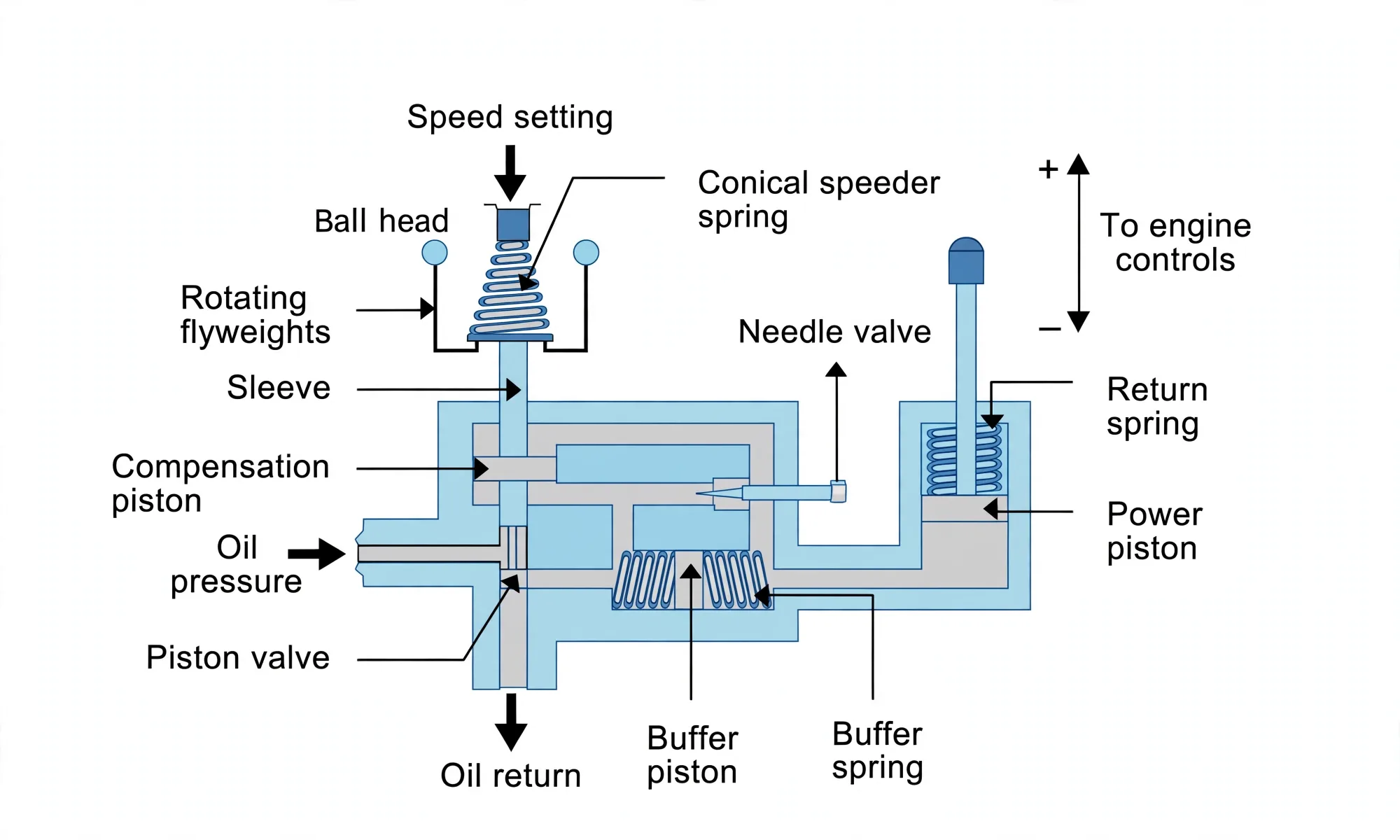
Same ball-head sensing, but sleeve motion pilots oil instead of hauling racks: falling revs drops the piston valve, pressure oil shoves the buffer piston right, displaced oil lifts the power piston — fuel setting rises. The genius is the compensation loop: buffer pressure imbalance pushes the compensating piston up, re-shutting the pilot valve before speed has even recovered, while a needle valve bleeds the imbalance away on the engine's own response timescale. Rising revs mirrors the sequence downward. Result: large corrective force with zero hunting, timed to the engine by needle setting.
4. Dead Band — the Silence That Steadies
Idea in one line: a governor that answers every tremor never rests — so a narrow band of deliberate silence around the set point keeps the racks still through harmless ripple (AP Singh p126).
Dead band is the band of controlled condition in which the controller takes no corrective action: small deviations inside it are ignored, large ones outside it are corrected. Its purpose is suppressing excessive fluctuation — without it, the governor would chase every wave-induced wobble and hunt itself (and the fuel racks) to exhaustion. The book's worked example: a measured value of 78° against the set point leaves a 2° offset inside the band — no action, by design:
Too narrow and the governor never rests — racks saw back and forth over noise. Too wide and sensitivity dies — the engine sits degrees off its set point with the controller serenely doing nothing. The band is a maker setting, proved on trials, not a watchkeeper's preference.