
Marine Batteries: Lead-Acid vs NiCd, Charging & 440/220 V Distribution
How a cell becomes a bank, why trickle beats cooking, and why motors drink 440 while lamps sip 220.
Key Principles at a Glance 5 points
- A cell converts chemistry to volts once; a battery strings cells — series adds volts, parallel adds amp-hours and cranking.
- Rest voltage tells truth only after hours idle: ~25.5 V full, ~24 V half, never below ~22 V on a 24 V bank — and never fully drain.
- Capacity shrinks as discharge rate grows (8/10/20 h ratings); charging returns ~85%, worse when rushed or nearly full.
- Lead-acid gives 2 V per cell cheap with surge power but sulphates and self-discharges; alkaline NiCd gives 1.2 V per cell, holds charge for months and shrugs off neglect, at higher cost.
- Trickle holds full banks against self-leakage; constant-voltage quick-charging fills fastest with a controller watching — and charging vents hydrogen, so ventilate, ban naked lights and wear apron, gloves and face shield.
1. From Cell to Bank — Volts Add One Way, Amp-Hours the Other
Idea in one line: series stacks voltage, parallel stacks endurance — pick the wiring that matches what the load is short of.
One cell: chemistry to volts. Many cells: a battery — series adds voltages (positive to negative down the line, amp-hours unchanged) for the volts you need; parallel (all positives together, all negatives together, matched cells only) adds amp-hours, cranking and reserve at unchanged volts. Lead-acid dominates starting duty: poor energy density, superb surge current per kilo, cheap.
Series — more volts
Voltages sum, amp-hours stay. Twelve 2 V lead-acid cells make a 24 V bank.
Parallel — more endurance
Capacities sum, volts stay. Banks sag less under heavy draw and yield more of their rating.
Rate matters
Fast discharges return less than slow ones — ratings quote their hour-rate (8, 10 or 20 h to terminal volts at 25 °C).
Reading charge: rested open-circuit volts (25.5 full → 24.0 half → ~22 cut-off on 24 V banks, measured after hours idle), but voltage sags under heavy draw — a big bank sags less. Capacity is amp-hours to terminal volts (about 1.75 V per cell): multiply discharge current by hours run. Never fully discharge — inverters cut out near 22 V to save the plates.
2. Lead-Acid vs Alkaline — Cheap Surge Against Patient Storage
Idea in one line: lead-acid wins the crank, alkaline wins the wait — chemistry decides which neglect kills.
| Lead-acid | Alkaline (NiCd) | |
|---|---|---|
| Electrolyte / plates | Dilute sulphuric acid; spongy lead plates | Potassium hydroxide; nickel and cadmium plates |
| Per cell | 2 V — fewer cells per bank | 1.2 V — more cells for the same volts |
| Strengths | Huge surge current per kilo, low cost | Robust, holds charge for months, tolerant of discharge and temperature swings |
| Weaknesses | Self-discharges fast, sulphates if left flat, needs more maintenance | Costlier, needs more cells per volt |
| Specific gravity | 1280 full → 1180 discharged — gravity tracks charge faithfully | ~1190 and barely moves — hydrometer tells little, volts and routine tell more |
Keeping them honest: both types want a regular top-up charge; lead-acid additionally wants a constant trickle. Log hydrometer readings through life, keep plates covered with electrolyte (top up with distilled water only), keep cases dry and clean, smear terminals with petroleum jelly. Partial-only cycling that never reaches full charge shortens life.
3. Two Ways to Fill — Quick to Refill, Trickle to Hold
Idea in one line: refill a flat bank fast under watch, then hold a full bank with a whisper so self-leakage never gets ahead.
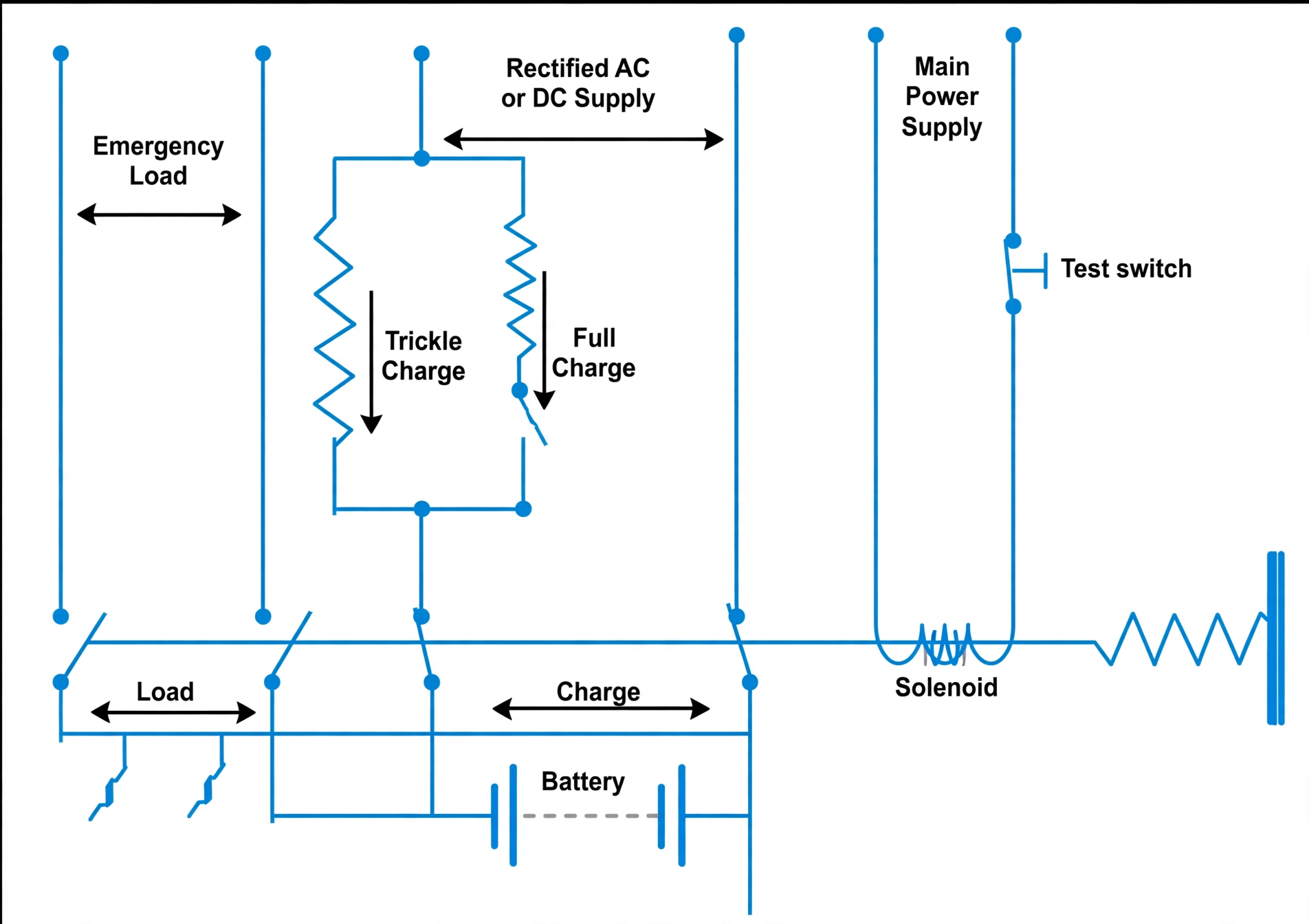
| Quick (constant-voltage) | Trickle | |
|---|---|---|
| When | Discharged bank needing refill fast | Full bank held against internal leakage |
| How | Fixed voltage applied; current follows the voltage gap (24 V systems need 30 V+ headroom) | Slightly above rated volts, small make-up current only |
| Watch | Charge controller mandatory — cooking a full bank destroys it; partial-only cycling shortens life | Efficiency ~85% overall, ~90% below half charge, ~60% above 80% |
Hydrogen warning: charging vents hydrogen. Ventilate the space, ban smoking and naked lights, and wear apron, gloves and face shield when working on batteries.
4. 440 for Muscle, 220 for Light
Idea in one line: high volts for heavy work keeps copper thin, low volts for fittings keeps people alive.
Motors drink 440 V three-phase because half the current means quarter the I²R losses and half the copper for the same power. Lamps sip single-phase 220 V because fittings, ballasts and humans are all rated safe there — stepped through >90%-efficient static transformers (preferred), or tapped phase-to-neutral at ~254 V with losses (tolerated, unpreferred).
440 V muscle
Three-phase motors and heavy loads. High volts, modest current, thin cables, small I²R heat.
220 V light
Lighting and small single-phase loads. Safer fittings, safer hands.
Tube and tester
Choke kick ionises the tube, phosphor turns UV white; neon tester glows on micro-amps — safe at 230 V only, never above its rating.
Tube-light strike in a line: choke kick ionises argon-mercury, phosphor turns UV white, starter drops out running. Neon tester in a line: 230 V micro-amps through body resistance glow without harm — within rating only.