
SOLAS Chapter XI — ISPS Code & Maritime Security
Special measures for maritime safety and security, permanent IMO hull markings, the 3 ISPS security levels, citadel hardening, and covert SSAS telemetry.
Key Principles at a Glance 6 points
- SOLAS Chapter XI is bifurcated into Chapter XI-1 (Special Measures to Enhance Maritime Safety) and Chapter XI-2 (Special Measures to Enhance Maritime Security), which makes the ISPS Code mandatory.
- Under Regulation XI-1/3, the IMO Ship Identification Number must be permanently marked on the hull or superstructure (>= 200 mm outside, >= 100 mm inside machinery or steering spaces) and remains unchanged throughout the vessel life.
- The Continuous Synopsis Record (CSR) serves as an unbroken statutory passport documenting all ownership, flag, class, and safety management history; it must remain permanently on board even upon ship transfer or sale.
- The ISPS Code defines three statutory Security Levels: Level 1 (Normal baseline at all times), Level 2 (Heightened risk for a period without a specific target), and Level 3 (Exceptional risk for a limited period against a specific target; set only by Governments).
- Restricted Areas (bridge, engine room, steering flat, emergency generator, bow thruster) require multi-tiered access control, key management, and anti-tamper sealing during elevated security levels.
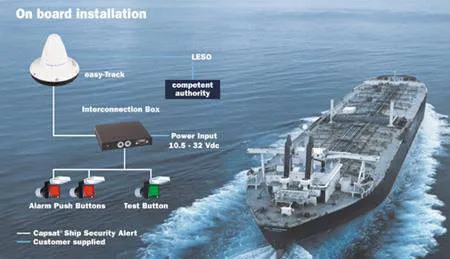
- The Ship Security Alert System (SSAS) utilizes covert activation points (bridge and at least one other secure location) to transmit a silent satellite distress message directly to the Flag Authority and CSO without generating any acoustic or visual indication on board.
1. Chapter XI-1: Ship Identification & Continuous Synopsis Record
Permanent IMO Ship Identification Marking (Regulation XI-1/3)
To eliminate fraudulent identity switching, phantom ship operations, and maritime piracy collusion, SOLAS Regulation XI-1/3 mandates that all passenger ships of 100 GT and upwards and all cargo ships of 300 GT and upwards must be permanently marked with an official IMO Ship Identification Number.
The seven-digit IMO number (preceded by the letters "IMO") is assigned by Lloyd's Register / S&P Global at the time of keel laying. Unlike radio call signs or vessel names, the IMO number is permanent and follows the physical hull from shipbuilder delivery to the final demolition scrap yard.
Continuous Synopsis Record (CSR) Mandatory Information Fields
| CSR Field Number | Statutory Record Content | Verification Document Required on Board |
|---|---|---|
| Fields 1 – 3 | Flag State, Date of registration under current flag, Ship's unique IMO Number. | Certificate of Registry (original held in ship's master safe). |
| Fields 4 – 5 | Ship Name and Port of Registry. | Certificate of Registry, Official Radio Station License. |
| Fields 6 – 8 | Registered Owner(s), Registered Address, and Owner IMO Identification Number. | Official Bill of Sale / Owner Registration Title. |
| Fields 9 – 11 | Registered Bareboat Charterer, Company managing ship, and Company IMO ID Number. | Bareboat Charter Agreement, Document of Compliance (DOC). |
| Fields 12 – 14 | Classification Society, Body issuing DOC/SMC, and Authority issuing ISSC. | Class Certificate of Hull/Machinery, SMC Certificate, ISSC Certificate. |
2. Chapter XI-2 & ISPS Code: Objectives, Legal Hierarchy & Security Levels
Legal Hierarchy & The Three Security Levels
SOLAS Chapter XI-2 (13 Regulations) forms the statutory anchor for the International Ship and Port Facility Security (ISPS) Code, which entered into mandatory international force on 1 July 2004.
The ISPS Code establishes an international risk-management framework to deter terrorism, piracy, armed robbery, and hostage taking. Central to the Code is the classification of operational threat into three distinct, standardized Security Levels:
Comparison of Security Measures Across Levels 1, 2, and 3
| Security Function | Security Level 1 (Normal) | Security Level 2 (Heightened) | Security Level 3 (Exceptional) |
|---|---|---|---|
| Access Control (Gangway) | Single access point; visual verification of photo ID; visitor badge issuance and logbook sign-in. | Limited access points; random search of persons, baggage, and carry-on gear; escorting of all non-crew. | Single controlled access point for emergency responders only; gangway lifted or guarded by armed security. |
| Restricted Areas | Locked when unattended; key control logged; signage posted; periodic security patrols. | Continuous security guard presence or electronic alarm monitoring; zero visitors permitted on bridge or engine room. | Total lock-down; restricted spaces evacuated and sealed with tamper-evident cable seals; full search. |
| Cargo Operations | Routine visual inspection of packaging, containers, and seals; verify against cargo manifest. | Detailed cargo checking; 100% seal checks on containers; random internal container inspections. | Immediate suspension of all cargo loading, discharging, and container transfers across the vessel. |
| Ship's Stores & Bunkers | Match deliveries against purchase orders; inspect packaging before embarking. | Detailed physical inspection and screening of all incoming stores and spare parts prior to loading. | Total refusal and suspension of all stores, provisions, spares, and bunkering operations. |
Under the ISPS Code, a ship's security level must never be lower than the security level set by the Port Facility. If a vessel operating at Security Level 1 enters a port designated at Security Level 2 by the Contracting Government, the Master must immediately elevate the ship to Level 2, notify the Company Security Officer (CSO), and execute a Declaration of Security (DoS) with the Port Facility Security Officer (PFSO) before commencing commercial operations.
3. Physical Vessel Hardening & Citadel Architecture (BMP5)
Anti-Piracy Engineering & Layered Defense (BMP5)
In High Risk Areas (HRA)—such as the Gulf of Guinea, Gulf of Aden, Red Sea, and Straits of Malacca—physical ship protection is engineered strictly per the Best Management Practices for Protection against Maritime Piracy (BMP5).
Defense is arranged in concentric defensive rings:
- Outer Perimeter: Razor wire concertina coils mounted on outboard steel brackets along the entire freeboard and poop deck, high-pressure water monitors, and evasive high-speed maneuvering.
- Superstructure Envelope: Heavy steel plates welded over lower portholes, deadlights bolted, external stairways secured, and accommodation doors locked with inner quick-release panic bolts.
- The Citadel (Safe Muster Point): A bullet-resistant, gas-tight armored refuge designed to keep the entire crew safe from armed boarders while maintaining radio communication with naval coalition warships.
Designated Restricted Areas & Security Controls
Navigation Bridge & Radio Room
Access strictly restricted to watchkeeping navigation officers. Doors locked in port; electronic key card or cipher lock access with visitor logging.
Machinery Spaces & Steering Flat
Access limited to licensed engineering personnel. Workshop and steering gear escape doors locked from inside with emergency push bars.
Emergency Generator & Fire Station
Critical auxiliary spaces housing life-saving power and emergency fire pumps must be locked and inspected during every security patrol.
HVAC & Ventilation Fan Rooms
Enclosed air-intake rooms are locked with tamper-evident serial cable seals to prevent toxic gas, biological agents, or chemical contamination.
4. Security Governance (SSO, CSO, PFSO) & Covert SSAS Alerts
The Security Triad: SSO, CSO, and PFSO
The human governance of the ISPS Code rests upon three designated statutory officers who maintain an uninterrupted chain of communication:
- Ship Security Officer (SSO): A licensed ship officer on board accountable to the Master, responsible for implementing the Ship Security Plan (SSP), directing drills, maintaining security hardware, and inspecting restricted spaces.
- Company Security Officer (CSO): A designated corporate shore official who performs the Ship Security Assessment (SSA), submits the SSP to the Flag State or Recognized Security Organization (RSO) for approval, and acts as the 24/7 shore emergency contact.
- Port Facility Security Officer (PFSO): An official designated by the port terminal responsible for developing the Port Facility Security Plan (PFSP), controlling waterside gates, and executing Declarations of Security.
Ship Security Plan — Language Rule & Ten Mandatory Contents (Q72a)
The SSP is written in the working language(s) of the ship, with a translation in English, French or Spanish. Recite its ten statutory contents as three groups — guard (3), respond (4), sustain (3):
- Guard — restricted areas + anti-access measures; anti-weapon/-device measures; ship-access control procedures.
- Respond — threat/breach response procedures; security-incident reporting; SSO identity; 24-hour CSO contact.
- Sustain — security duties of shipboard personnel; SSAS activation-point locations; training, drill and exercise procedures.
SSAS Fitment Dates — Four Ship Groups (Q71)
Ships built on or after 1 July 2004 carry SSAS from delivery. Older ships fit it not later than the first radio survey after:
- After 1 July 2004 — passenger ships incl. high-speed passenger craft; oil/chemical/gas/bulk/cargo high-speed craft ≥ 500 GT.
- After 1 July 2006 — other cargo ships ≥ 500 GT and MODUs.
Comparison of Security Roles: SSO vs. CSO vs. PFSO
| Security Officer | Station / Operational Base | Primary Statutory Duties | Mandatory Drill & Exercise Intervals |
|---|---|---|---|
| Ship Security Officer (SSO) | On board individual vessel; directly accountable to Master. | Executes Ship Security Plan (SSP); maintains restricted areas and physical hardware; trains shipboard crew; manages gangway access. | Conducts shipboard security drills at least every 3 months (or within 1 week if $>25%$ of crew changed). |
| Company Security Officer (CSO) | Shore headquarters; maintains 24/7 emergency availability. | Conducts Ship Security Assessments (SSA); drafts and updates SSP; arranges external Flag/RSO audits; liaises with SSO and PFSO. | Participates in company-wide security exercises at least once every calendar year (max 18 months interval). |
| Port Facility Security Officer (PFSO) | Port marine terminal / waterfront facility. | Maintains Port Facility Security Plan (PFSP); verifies terminal gates, CCTV, and waterside fences; countersigns Declarations of Security. | Executes full-scale port facility security exercises at least once every calendar year. |