
Purifier Operation — Separation, Start-Up & Oil Limits
How spin separates oil, water and sludge, the start-up sequence that proves the bowl, and the water limits that condemn oil.
Key Principles at a Glance 6 points
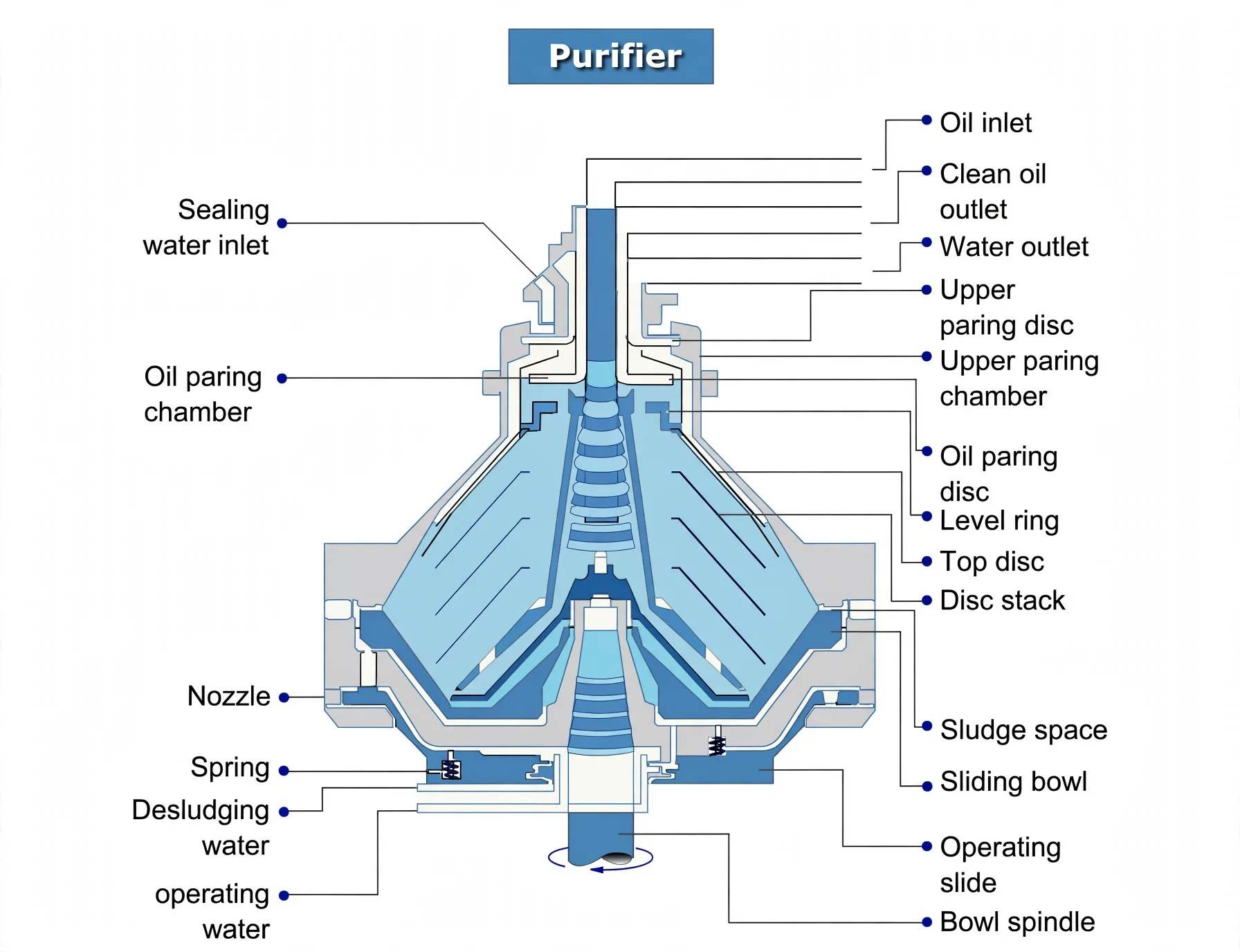
- Spin replaces gravity: dense water and sludge fly outward to the sludge space while clean oil migrates inward to the paring chamber.
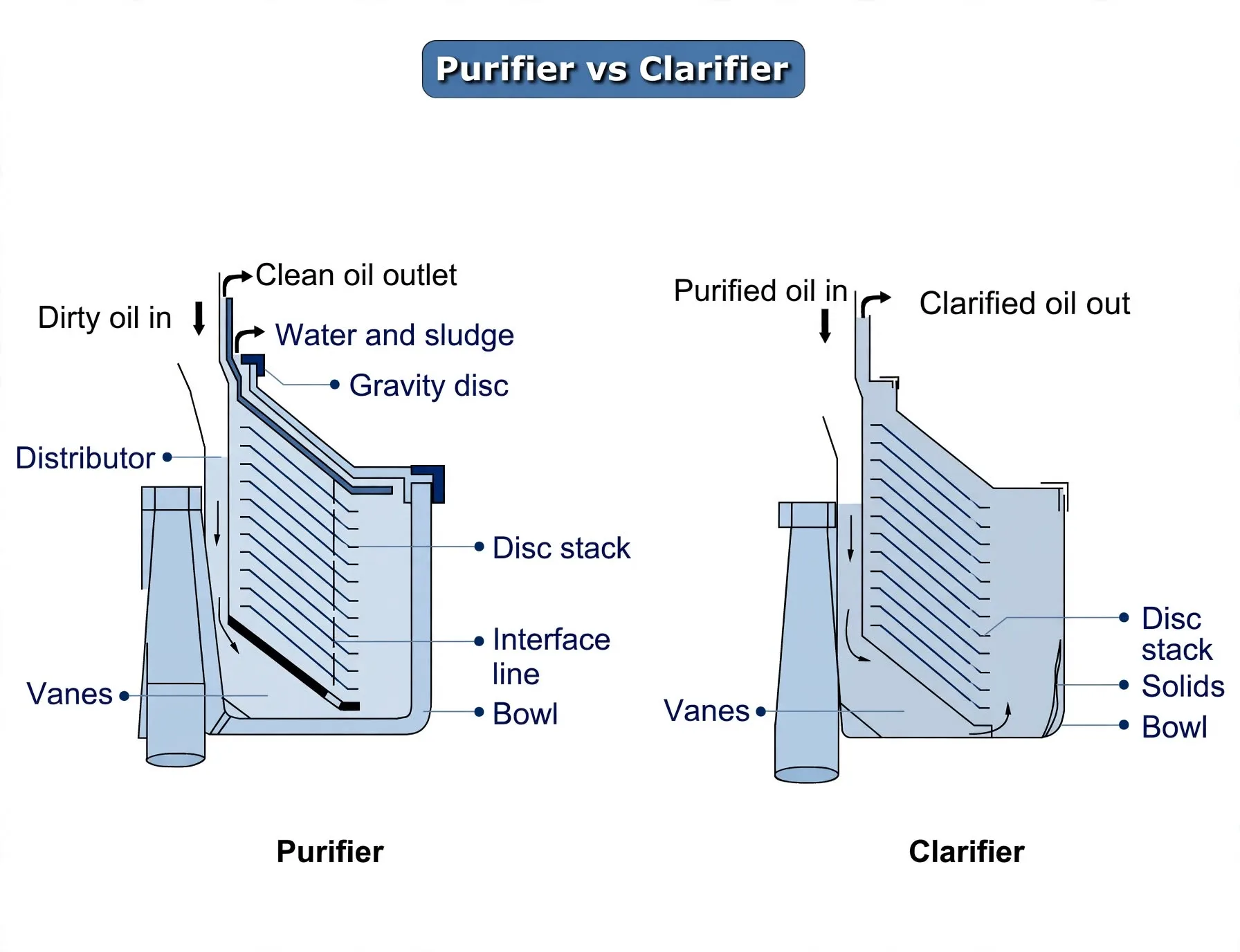
- A purifier holds an oil-water interface with a gravity disc; a clarifier has no disc and no water seal — it strips solids only.
- Separation quality obeys eight factors: temperature, speed, back pressure, throughput, sludge space, water proportion, particle shape, and disc-stack condition.
- Start-up proves the bowl before oil enters: close with operating water, seal with water to overflow, fire a test desludge and listen for it — twice.
- Crosshead oil tolerates under 0.2% water and dies above 1%; trunk engines demand under 0.1% — fuel dilution thins viscosity and invites crankcase explosion.
- The small LO purifier is a different machine: 1-quart mist reservoir, 70-strokes speed proof, funnel prime, 6–8 psi head, and port readings that diagnose the incoming oil.
1. How Spin Separates Three Phases
Idea in one line: the bowl is a gravity tank spun thousands of times harder, so density alone decides where everything parks.
Dirty oil enters at the centre and is flung outward. Heavy stuff wins the outside — water and sludge pack against the periphery. Clean oil loses and drifts inward.
Sludge — outermost
Solids and heavy sludge plaster the inside wall of the bowl. This is the sludge space. When it fills, flow inside is disturbed.
Water — middle ring
Separated water forms a ring inside the sludge layer. It leaves through the heavy-phase outlet over the gravity disc.
Clean oil — centre
Lightest phase travels inward through the disc stack, rises over the level ring, and a stationary paring disc pumps it out the clean outlet.
Why the disc stack matters: its narrow channels keep every streamline thin. A droplet is always near a metal surface, so it can touch, merge, and grow heavy enough to fling out — instead of riding through.
2. Purifier vs Clarifier — the Interface Decides
Idea in one line: a purifier balances two liquids against each other; a clarifier has only one liquid, so there is nothing to balance.
Purifier — two liquids
Separates oil from water plus sludge. Holds a water seal. The boundary between oil and water is the interface, and the gravity disc positions it.
Clarifier — solids only
Strips solids from one liquid. No gravity disc. No water seal. No interface to hold — simpler, but blind to water.
How the disc steers the interface: the interface sits where the oil column and the water column balance. The disc is the water outlet — its hole size sets how easily water escapes.
| Disc change | What happens to water | Where the interface goes |
|---|---|---|
| Larger hole | Water escapes easily | Moves outward to the periphery |
| Smaller hole | Water held back | Dragged inward to the centre |
| Rule | Fit the largest hole that still holds the water seal — maximum water capacity with the seal intact | |
Which way round? Disc diameter runs inverse to oil density — denser oil needs a smaller hole. Take density from the bunker delivery note, then read temperature and disc size from the nomogram with throughput.
3. The Eight Factors That Decide Quality
Idea in one line: five settings you control every watch, plus three hidden ones that explain failures surviving correct settings.
The five you set
| Factor | Why it works | What you do |
|---|---|---|
| Temperature | Heat thins viscosity and widens the density gap — the two biggest levers | Heater to bunker-report optimum, held constant |
| Full RPM | Force grows with speed squared — a slow bowl barely separates | Prove rated speed on the revolution counter before feeding |
| Back pressure | Keeps the paring disc dipped in clean oil so it can pump onward | Trim after starting, re-trim as temperature and density drift |
| Throughput | Flow sets settling time — rushed oil leaves dirty | Minimum that meets demand; cut further for wet oils |
| Sludge space | A full wall layer disturbs internal flow and efficiency collapses | Desludge every 2 hours heavy oil, 4 hours lube oil |
The three that ambush you
Too much water in
The stack can only ferry so much heavy phase outward per pass. Extra water overloads it — cut throughput, drain free water upstream first.
Particle shape and size
Round and smooth settles fast; irregular drags. Large beats small at equal density. Rough pumping shears particles smaller — handle oil gently.
Stack condition
Bent discs warp the thin channels; deposits coat the merging surfaces. Inspect every strip — renew damaged discs, descale coated ones.
Name the five first, then offer the three when pushed. Surveyors reward the candidate who knows what survives correct settings.
4. Start-Up That Proves the Bowl
Idea in one line: prove the bowl dry, prove it sealed with water, prove it fires — only then let oil in.
Self-cleaning bowls discharge without stopping. Automatic plants do closing, sealing, feeding and timed desludge from one button — starting is the only manual act. Learn manual and you can run either.
Targets first: density from the bunker delivery note → temperature and disc size from the nomogram. The revolution counter reads scaled-down bowl speed through the manual's ratio — look it up once.
Pre-checks — remove the triggers. Post-overhaul fittings correct, hood locked, gear oil half-glass, rotation bump-tested, brake released. Confirm operating-water tank is full — an empty tank opens the bowl mid-run.
Spin dry — listen before loading. Feed pump recirculating to settling tank, heater drains open till steam shows then shut. Start the bowl. Amps surge, then fall to normal at rated RPM. Any gear noise or vibration now is mechanical, not oil — fix it before feeding.
Close, seal, test-fire — twice. Operating water closes the bowl. Wait 10 seconds. Sealing water runs till it overflows at the waste outlet, then stops. Fire a test desludge and listen — the bang proves closure; silence means it never closed. Repeat the whole cycle. Two proofs because one can fool you.
Feed and trim — watch the waste. Swing the 3-way valve to feed. Wait for back pressure. Eyes on waste outlet and sludge ports — dirty oil there means stop, not adjust. Set throughput and back pressure per manual, then swing clean discharge to the service tank.
On watch — trim the drift. Temperature, density and viscosity drift, so throughput, back pressure and feed temperature are re-trimmed. Log amps, gear oil, leaks, vibration. Desludge 2-hourly heavy oil, 4-hourly LO.
Stop wet — never bake sludge on. Stop feed. Desludge. Shut steam. Flood the bowl with water. Stop the machine, brake to rest. Emergency stops kill feed instantly and stop the machine.
The upper paring disc and flow-control disc keep oil circulating inside the bowl top. That circulation holds a minimum temperature rise in the upper paring chamber — without it the top cools, viscosity climbs, and the clean end suffers.
5. Water & Fuel Limits That Condemn Oil
Idea in one line: a little water disables cooling and breeds acid; a lot kills bearings — fuel in oil thins it toward explosion.
Where water comes from: crankcase condensation, cylinder and piston-cooling leaks, sump steam-coil leaks.
What it does, in order: steals cooling → grows crankcase acids → corrodes → feeds microbes → kills TBN → emulsifies into sludge.
Fix: purify at minimum throughput. Heavy contamination gets batch treatment (full ritual lives in the faults lesson).
Fuel in oil — the thinner that explodes
Causes: bad atomisation, injector-pump back-leak past plunger and barrel.
Effect: viscosity falls so load capacity collapses, and flash point falls toward crankcase-explosion territory.
| Clean-up route | Takes out |
|---|---|
| Filtering | Large insolubles |
| Gravity settling | Heavies, sludge, water |
| Additives | Acids, fines |
| Centrifuging | Sludge, foreign matter, water |
| Water washing | Acids — straight mineral oils only |
6. Lube-Oil Purifier Start — the Small High-Speed Type
Idea in one line: different machine — funnel-primed, mist-lubricated, and its discharge ports read the incoming oil for you.
Oil the mist — engine stopped. Filler cap with dipstick off, about 1 quart in, never overfilled, never while running. The helical gear flings this oil into the mist that lubes every internal part.
Free the bowl. Brake and lock screws released, cover open, bowl correctly rebuilt and spinning freely by hand. Tight now means wrecked bearing later.
Clamp and line up. Cover and inlet arm clamped hard. Discharge and suction valves open to their tanks — suction-pump inlet left shut for now so the pump can prove speed unloaded.
Prove speed. Start the pump, press the speed indicator. Plunger must read 70 strokes per minute or more.
Prime with water. Pour water into the top funnel until it drains from the discharge port. Drainage means the bowl is full and the seal is standing.
Feed gently. Crack the inlet slowly. Hold 6–8 psi discharge head. Hold oil at 160–165 °F.
Read the ports — they diagnose. Oil port 1/8 full. Water port: no oil, little or no water. Heavy water here is not a setting error — the incoming oil is contaminated, so hunt the source.