
Purifier Bowl & Drive Maintenance — Heights, Conversion & 8000-Hour Service
Why bowl parts are married sets, how a water pulse fires sludge out, where the bowl must sit, and the measurements that condemn each part.
Key Principles at a Glance 8 points
- Bowls are balanced only as complete assemblies — never swap parts between separators, not even same-type sisters.
- Isolation is seven locks before the first bolt: both breakers with permit, all three waters, feed and discharge, heater steam, proven standstill, brake, board.
- Desludging is hydraulics: opening water drops the operating slide, bowl pressure drives the sliding bottom down, sludge ports fly open.
- Every sealing face has a number: 0.5 mm slide-profile limit, 20 Nm dosing screws, 1 mm hood-seal indent, washer triple renewed as a set.
- Horizontal drive lives or dies on the worm pair: 2 mm wear condemns the wheel, worm and wheel renew together, pads renewed as a full set.
- Vertical-spindle health reads as vibration plus deposits: buffers, 0.5 mm housing limit, radial wobble, hand-turn paring height — black means dead oil, pits mean wrong additives.
- Bowl height is proved before and after assembly — straight edge on the shaft, vernier to the frame (about 40.4 ± 0.5 mm) or the GO NO-GO gauge: high means ports never close and oil overflows, low means ports never open and sludge stays.
- Purifier becomes clarifier in four swaps — sealing water off, hole-less disc, neck-less top disc, bush for the gravity disc — and the clutch exists so a sludge-heavy bowl spools up gradually and slips instead of burning the motor.
1. The Balance Law — Bowls Are Married Sets
Idea in one line: the factory balances the whole spinning mass, not the parts — so any part swap is a new, unbalanced rotor.
A bowl at full RPM multiplies every gram of asymmetry into shaking force. That is why major parts can never be replaced without rebalancing the entire bowl, and no part migrates to another separator — even an identical one.
When it shakes, the cause is one of these: poor cleaning, wrong assembly, missing discs, slack hood, foreign parts, wrong paring-disc height, bent spindle, worn bearings, dead top buffers.
Isolation — seven locks before the first bolt
Each lock removes one energy that can kill: electricity, pressure, heat, rotation.
Stop and lock electrics. Machine stopped. Control-room breaker off. Permit taken, local panel breaker off. Two breakers because one can be reclosed by someone else.
Shut every liquid and steam. Operating, desludging and sealing waters shut. Feed inlet and oil discharge closed. Heater steam shut — hot oil keeps burning after stop.
Prove death, then brake, then board. Rotary indicator must read standstill before the brake goes on — braking a spinning bowl wrecks it. Hang the men-at-work board last so nobody re-energises.
2. How a Water Pulse Fires Sludge Out
Idea in one line: water is the trigger, bowl pressure is the gun — the slide only aims, the oil pressure fires.
Closing — water lifts both
Closing water fills under the operating slide and pushes it up. The sliding bowl bottom rides up with it. Ports shut and stay shut while pressure holds.
Opening — water drops, pressure slams
Opening water feeds the discharge mechanism and drains through the body nozzles. The slide falls. Full bowl pressure slams the bottom down, ports fly open, sludge fires out — then water shifts and the bottom is pressed straight back up.
Two failure sentences to memorise: lime or dirt in the mechanism means weak or no discharge. A leaking hood-to-slide seal bleeds process liquid continuously, closed or not.
Service limits on the sealing path — measure, don't eyeball
| Part | What kills it | Limit / method |
|---|---|---|
| Slide sealing edge | Corrosion and erosion eat the profile | Re-turn in a lathe, max 0.5 mm off the original height |
| Bowl body | Worn nozzles, marked slide face | Exchange nozzles; steel-wool polish; whetstone on slide-contact marks |
| Slide springs | One weak spring tilts the slide | Renew any spring differing in length or looking defective — weak springs stop full closing |
| Slide faces | Lime and marks leak past plugs | Three plug faces with very-fine emery; guiding face with whetstone only |
| Dosing nozzles + screws | Blocked jet, jammed slide | Clear jets with soft iron wire; torque screws to 20 Nm with a meter — more jams the slide |
| Valve plugs | Burrs and galling leak | Knock in with rubber mallet, colours matched (black, red, green sets); check faces |
| Hood seal ring | Indent flattens the seal | Renew at each intermediate service if damaged or indented past 1 mm |
| Lock ring | Worn threads gall under load | Any wear or impact on threads or faces condemns it — galling is hazardous, never dress and reuse |
| Paring disc | Lime coats, wrong height scrapes | 10% acetic at 80 °C for lime; shim rings (H) under the distributing cover; hand-turn test below |
Refit inlet and outlet, turn the worm-wheel shaft by hand. Heavy turning or scraping means wrong height or a wrongly fitted inlet pipe. Recheck height after any spindle strip or bowl swap.
3. Horizontal Drive — the 8000-Hour Strip
Idea in one line: motor speed enters sideways through a worm, and a slipping clutch protects the gears — inspect the wear pair, the sacrificial pads, and the bearings on a fixed clock.
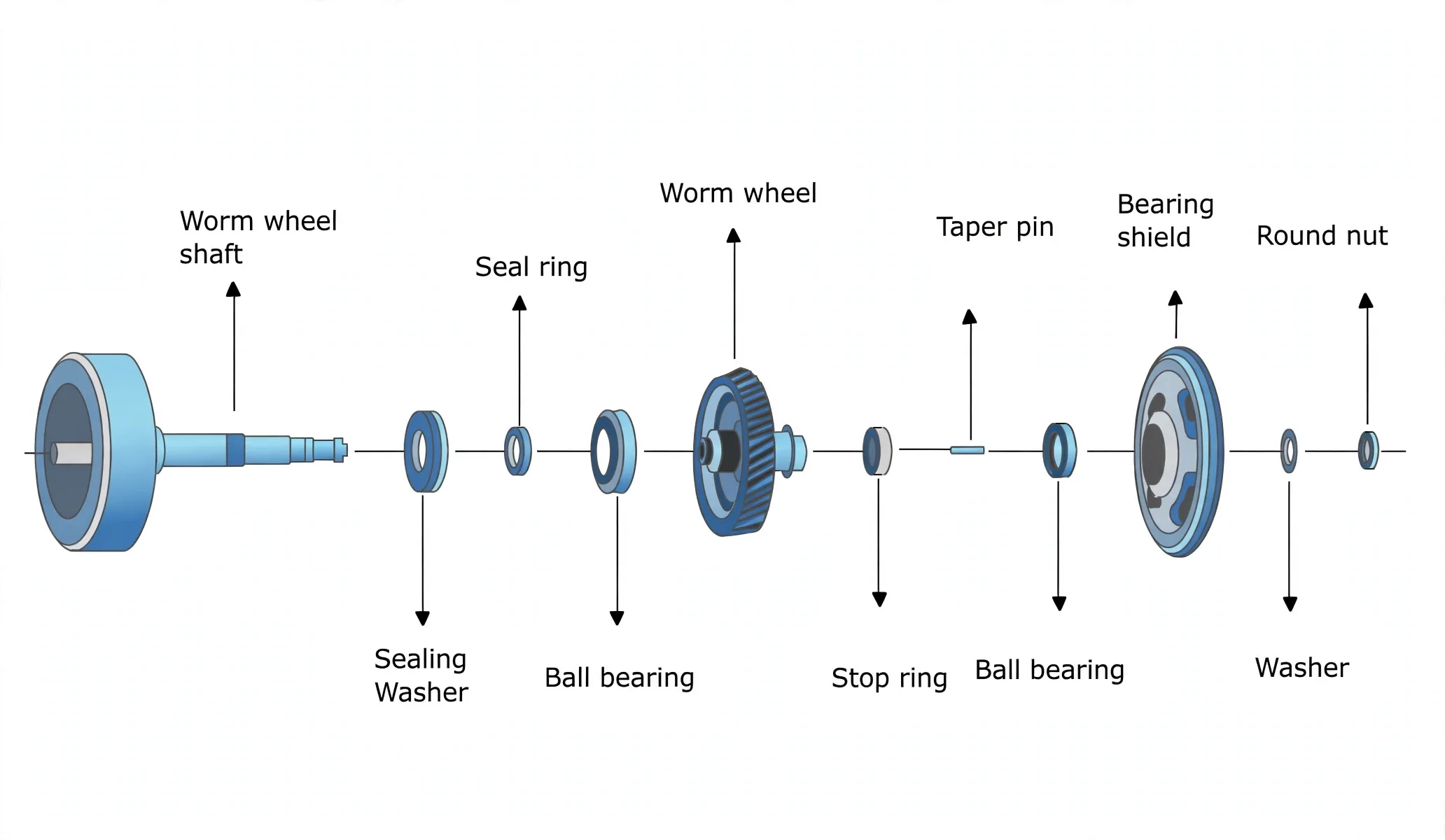
| Assembly | Why it fails | Check and limit |
|---|---|---|
| Worm + wheel | Sliding contact wears teeth; wrong additives pit them | Wheel condemned past 2 mm wear; compare tooth profiles — matched wear can still run; renew worm and wheel together; metal chips in bath mean abnormal wear |
| Bearings | Hours kill them silently | Renew every 8000 hours regardless; check bores for scoring, shields for dents, taper pin and round-nut threads for burrs; dress minor shield marks with file or fine emery |
| Shaft in drum | Bearing seats indent, faces rub | Renewable inside the coupling drum; check axial play vs maker allowance; inspect mating faces for abrasion; degrease drum with agent |
| Seal triple | They seat as one matched face | Sealing washer, seal ring and lock washer renew as a complete assembly even if one alone is damaged |
| Friction clutch | Worn or oily pads slip instead of grip | Not full speed in 10 minutes means inspect — clean or renew the complete set even for one worn pad; no spares means dress, refit, indent |
Black deposits mean the gear-oil base died or additives precipitated — change the oil habit, not just parts. Pits on the worm mean the additives were wrong for the duty.
4. Vertical Spindle — Vibration Tells Everything
Idea in one line: the spindle stands on springs so the bowl can centre itself — dead springs let it orbit instead of spin.
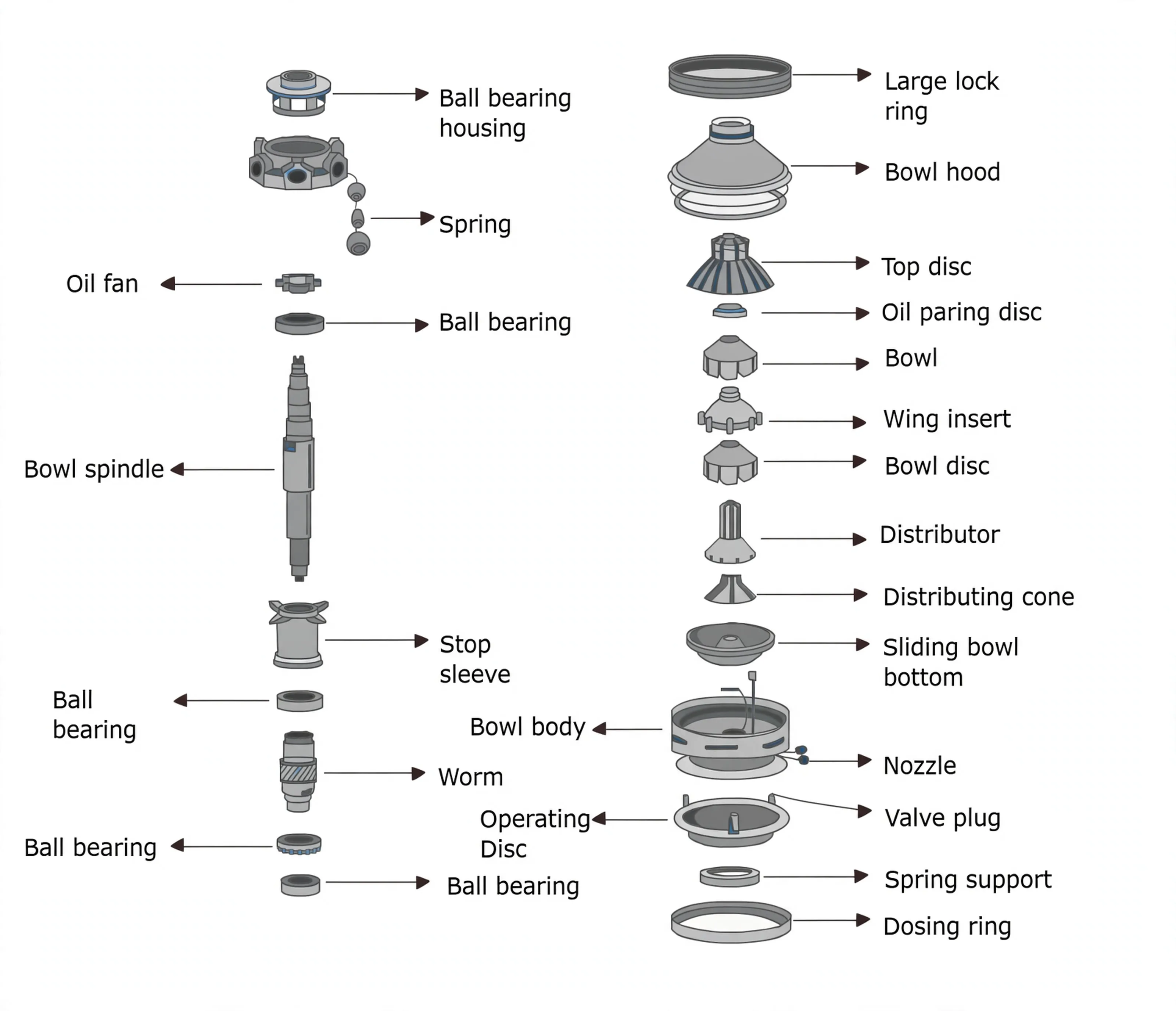
Strip order that avoids damage: inlet and outlet parts off, then frame hood, then bowl, then the operating-water paring device. Spindle comes out last and goes back first. Clean everything, check the spindle top, renew seals and O-rings by the maker's schedule — not by looks.
| Check in order | Why | Limit / action |
|---|---|---|
| Top bearing springs | Weak springs let the bowl orbit | One broken spring condemns the whole set |
| Housing buffer seats | Dented seats tilt the buffers | Indents past 0.5 mm condemn housing, buffers and springs together |
| Radial wobble | Bend shows as runout | Check every 8000 hours and after any rough-run strip |
| Spindle height | Wrong height misplaces the whole bowl | Verify against frame-ring edge; tap the top with a tin hammer first — an unseated bottom bearing fakes a height error; §5 gives the bowl/shaft numbers, conversion recipe and clutch logic |
| Bearing seats | Thinned seats fret and spin | A thinned seating area condemns the shaft itself |
| Cone | Rust welds bowl to spindle | Scraper and oil-stone for marks, fine emery finishing very fine for rust |
5. Heights, Conversion & Clutch — Where the Bowl Sits Decides Everything
Idea in one line: the bowl floats on water films fed through fixed ports — move the bowl a millimetre and the ports miss, the seal fails, and the machine confesses by overflowing.
Measuring bowl height (Clyde). Check before and after every bowl assembly — seating changes the number. Lay a straight edge across the top of the vertical shaft, measure down to the frame with vernier or scale (example 40.4 ± 0.5 mm), or span the same two points with the GO NO-GO gauge. Two numbers, two datums: bowl height reads frame-to-bowl-nut, shaft height reads shaft-top-to-frame.
| Height | Space lost | What you see |
|---|---|---|
| High — bowl rides up | Closing-water chamber shrinks, feed holes misalign | Sludge ports never close → oil overflow; with holes mismatched no operating water enters at all |
| Low — bowl sits down | Opening-water chamber shrinks, feed holes misalign | Ports never open → no desludge; sludge and water creep to the oil side, leakage |
When to check: bearing wear-down announces itself as vibration — that vibration is the height-change alarm, so check at once. Recheck after any spindle strip, bearing renewal or bowl swap (see the hand-turn proof in §2). Drift carries three signatures: bowl sealing goes improper, bowl weight settles onto the shaft so RPM sags, and the operating-water holes stop coinciding so the bowl can neither desludge nor receive water.
Purifier ↔ clarifier conversion — four swaps, one idea
Converting kills the interface: no seal water, no water-outlet path, nothing left to position. Reverse every step to go back. Why each swap works is §2 of purifier-operation — this is the spanner-work recipe:
Shut the sealing water. A purifier runs on a water seal; a clarifier runs dry. Leave it cracked and water keeps entering a machine with no water outlet.
Fit the disc without holes. One unbroken disc forces the single-liquid path — oil in, oil out, solids to the wall.
Top disc without neck. The neck is the water-outlet passage; a neck-less top disc deletes it.
Bush for the gravity disc. With no interface to position, the water-outlet ring comes out and a bush plugs its seat.
Why the clutch exists — gradual load, slip fuse
Spinning a heavy bowl from rest demands very high torque — worse with a sludge-loaded bowl — and a direct drive would overheat the motor or trip it on overload. Three ferrodo-lined pads ride in a drum on the motor shaft: at standstill they sit retracted, and as the motor spins, centrifugal force flings them out to kiss the drum — slipping first, gripping progressively — so the horizontal shaft eases to rated speed instead of jerking there. If bowl or drive jams, the pads keep slipping instead of stalling the motor: slip is the fuse. Inspection limits live in §3 — not full speed in 10 minutes means open it up.