
Switchboards & Protection — MSB to Emergency Bus
What guards the main bus, how preferential and reverse-power trips think, and the switch that never parallels wrong.
Key Principles at a Glance 5 points
- MSB defence is layered: dead-front construction plus fuses, relays, breakers, earth and undervoltage sensing — backed by gloves, mats, gaps and earthed doors.
- Preferential trip sheds luxury load to save the bus; reverse-power trip (5–15% motoring, 0.5–3 s) sheds a generator that turned into a motor.
- Breakers reset where fuses die: shunt coils trip on command, UV coils on vanished voltage, thermal elements on slow overload.
- ABT feeds the emergency bus from whichever source lives — mains, emergency set or shore — while mechanically forbidding any paralleling of them.
- Steering feeders tolerate 300–375% (DC) or 175–200% of locked-rotor (AC) before tripping — steering must survive faults that stop everything else.
1. MSB Safeties — Built In and Worn
Electrical (in the steel)
Dead-front construction, fuses, protective relays, breakers, earth-fault indication, undervoltage and reverse-power relays, overcurrent and short-circuit trips, arc chutes — plus an ebonite rod for bleeding static charge.
General (on the person)
Insulated gloves, dry boiler suit, metal-free shoes, rubber mat at the front, 0.6 m clear behind, earthed panel doors with interlocked handles — and no water, oil or steam pipe routed anywhere near.
2. Two Trips That Get Confused
| Preferential trip | Reverse power trip | |
|---|---|---|
| Protects | The bus — sheds non-essential load so generators survive overload | The prime mover — trips a generator feeding backwards into the bus |
| Trigger | Bus overload rising toward blackout | Prime-mover failure lets the grid motor the set (5–15% of motoring power, 0.5–3 s delay) |
| Whose safety | System safety | Generator safety — it stops motoring, never the bus |
Test reverse power by paralleling two sets, shifting load across until the unloaded breaker trips on governor control — or by relay simulation. Low load that lingers also invites motoring, which is why load sharing is watched, not assumed.
3. Breakers — Resettable Fuses With Brains
Air, oil, vacuum and SF₆ families all quench arcs in their own medium. Service, mechanism and voltage class sort the rest.
Three trip units give a breaker judgement:
Shunt trip
A solenoid that trips on applied voltage (remote command).
Undervoltage
Trips when control voltage itself vanishes.
Thermal
Slow overcurrent heating that mimics the cable it guards.
Fuses melt once; breakers think and reclose.
4. ABT — the Switch That Never Parallels Wrong
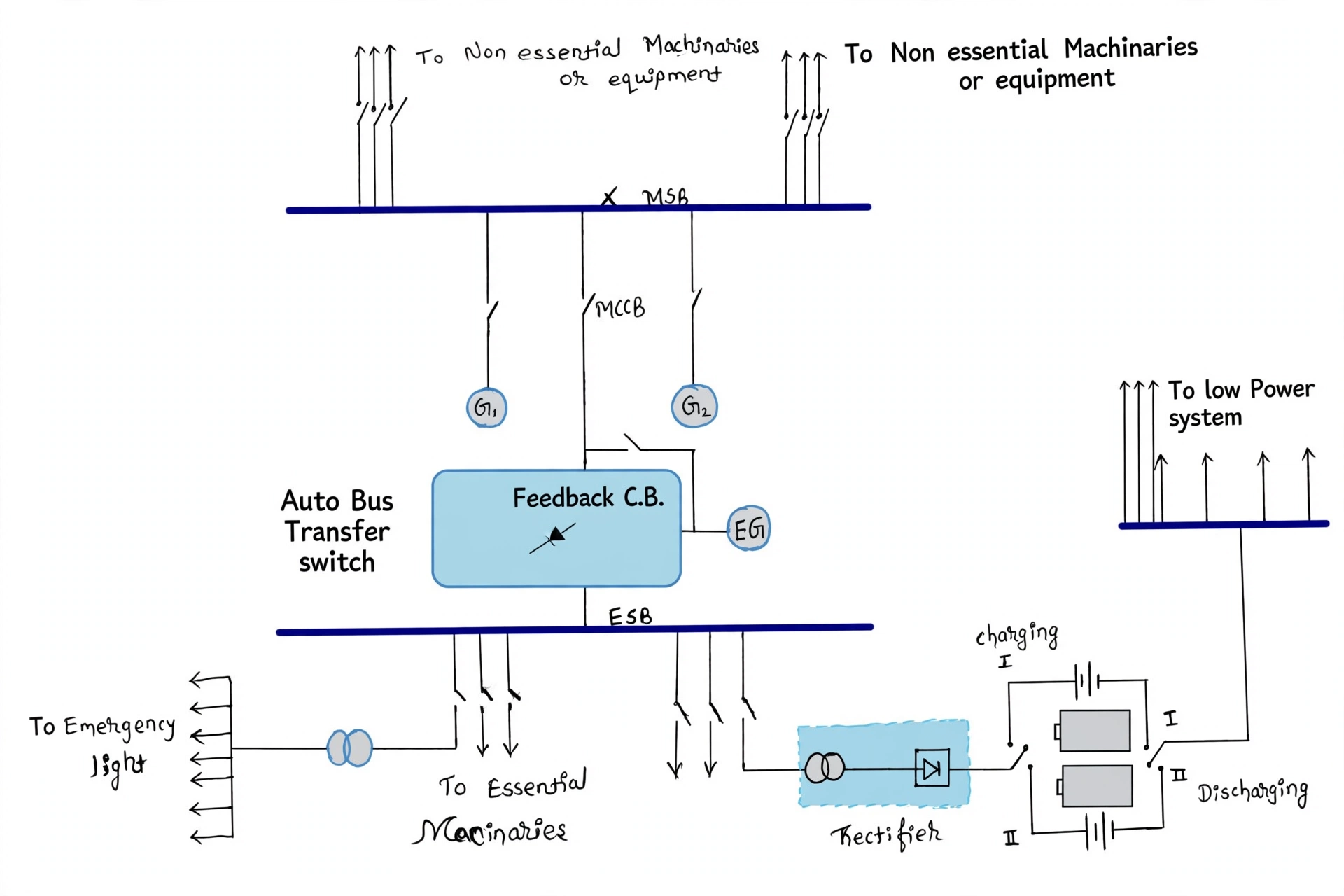
The automatic bus-transfer switch feeds the emergency board from live mains, throws it to the emergency generator on mains failure (shore failure included), and mechanically forbids paralleling main, emergency and shore sources together. Steering feeders ride through faults on 300–375% instantaneous (DC) or 175–200% of locked-rotor current (AC) — steering keeps turning when lesser loads trip.
5. Touching Busbars — Dead or Dead Careful
Dead work (drydock or blackout): doors open, copper and bolts eyeballed for missing and burn marks, tap-tested gloved for looseness, insulators checked, nuts torqued, breaker wiring tightened, vacuum-cleaned, strays removed — and any loose joint re-tightened only with its bus and neighbours dead. Live rounds (highest PPE, load noted): infrared gun on plates and joints against load-indexed limits — 50 °C on a half-loaded 28 °C room is healthy, hotter is an investigation, not an observation.
6. Breakers That Refuse, Faults to Hunt, Steering That Stays
ACB discipline: Air Circuit Breakers rule generator currents at 400 V-plus. Stab CLOSE on an idle unsynchronised set and the undervoltage interlock refuses — no control volts, no closure, no blind paralleling; the same unit guards connected machinery against brownout sag. Earth-fault alarm drill: indication means a phase has found hull — suspect deck lighting and galley gear first, drop feeders one by one until the alarm clears, then repair that circuit dead. Steering stays turning: overload and high-temperature alarms, insulation monitoring, self-restart after blackout, short-circuit and phase-failure trips, one motor fed from the emergency bus — hydraulically backed by low-level cut-out and high oil-temperature cut-out.