
Fresh Water Generator — Vacuum Boiling, Operation & Faults
How 92% vacuum lets engine waste heat boil seawater at 50 °C, and what high salinity or low output is telling you.
Key Principles at a Glance 6 points
- Vacuum is the whole trick: near-92% vacuum drops the boiling point so ~80 °C jacket water evaporates seawater at ~50 °C shell temperature.
- Vacuum is also the most fragile thing — any air leak or sick ejector kills output before anything else breaks.
- Roughly half the feed becomes distillate; the ejector must continuously remove the other half as brine or density climbs and carry-over follows.
- High salinity points at feed rate, evaporation temperature, brine level, leaking tubes or a dirty probe; low output points at scale, vacuum, ejector, jacket heat or the distillate pump.
- Low-temperature distillate is never sterile and never made near coasts — chlorination, electro-katadyn or UV plus offshore-only production.
- Reverse osmosis is the rival method: seawater forced through spiral-wound membranes, output set by pressure, temperature and salt load.
1. Why Vacuum Turns Waste Heat Into Fresh Water
Idea in one line: lower the pressure and water boils cooler — so engine jacket water too cool to boil anything on deck becomes a boiler inside a vacuum shell.
At atmospheric pressure seawater boils near 100 °C and jacket water at ~80 °C could never touch it. Pull the shell down to ~92% vacuum and the boiling point collapses to ~50 °C — suddenly that same jacket water is a strong heating medium. Seawater evaporates, salt stays behind in the brine, and the vapour condenses on seawater-cooled tubes as distillate. Heating medium is jacket water or steam; the unit is a self-contained vacuum package.
What lives inside the package: coated mild-steel shell, vertical-tube evaporator bundle, shell-and-tube condenser, brine-and-air ejector with its pump, distillate (condensate) pump, vacuum gauge, distillate level gauge, salinometer, dosing connection and a shell relief valve. One saturation pressure rules both chambers — evaporation and condensation sit at the same boiling point for that vacuum.
2. Start-Up — Vacuum First, Heat Last
Idea in one line: the start sequence builds the vacuum trap before letting any heat or feed in — feed without vacuum just fills the shell with salty water.
Ejector lines open, pump started, ≥ 3 bar proved — suction, discharge and overboard valves open first. Why: the air ejector is the vacuum pump; weak motive pressure means no vacuum ever builds.
Wait for ~92% shell vacuum on the gauge — feed nothing until it arrives. Why: no vacuum, no low-temperature boiling, no water.
Crack the feed valve, set feed pressure and flow — restricted feed, not full bore. Why: only about half the feed can flash; flooding the chamber drowns boiling and pushes brine toward the demisters.
Admit jacket water gradually, vent the evaporator top until solid — open inlet and outlet slowly, crack the air vent until water-filled. Why: sudden heat shocks tubes and trapped air blankets heat transfer.
Salinometer panel on, distillate pump primed, product to nominated tanks — watch the suction sight-glass for solid prime. Why: an air-locked distillate pump cavitates while off-spec water could already be heading for the tanks.
3. Running Watch — What Each Reading Means
Idea in one line: every gauge is an early warning for one failure — flashing stops means heat or vacuum went, brine rising means the ejector stopped clearing.
| Check | Normal | Drift means |
|---|---|---|
| Flashing in shell glass | Lively boiling visible | Dead glass: vacuum lost or jacket heat gone |
| Brine level | Steady, neither high nor low | High: ejector nozzle clogged or overboard shut; low: feed starved |
| Shell temperature / vacuum | ~50 °C, vacuum above 90% | Temperature up with vacuum down: air leak — the single most important reading |
| Condenser seawater in/out | Sensible temperature rise | No rise: over-cooled evaporator or flooded condenser |
| Ejector, distillate, dosing, amps | Ejector > 3 bar; steady distillate flow; dosing flowing; normal currents | Sagging ejector pressure, swinging amps or empty doser precede the fault tables below |
4. Plate vs Flash — Where Every Stream Goes
Idea in one line: both designs flash seawater into steam and scrub the salt spray out before condensing — plate type boils in place, flash type boils by falling pressure.
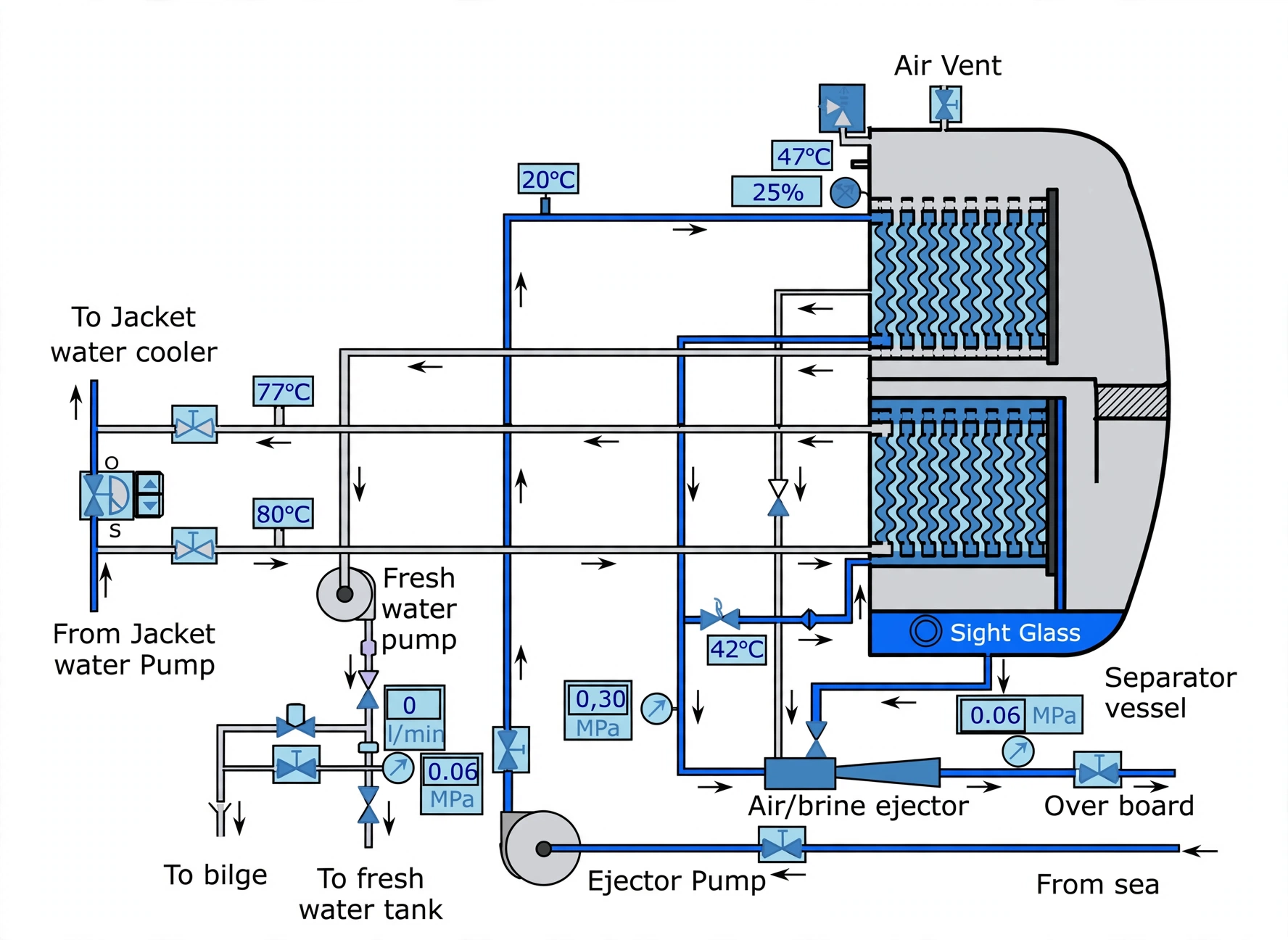
Plate type in detail: hot jacket water crosses the heated nest while restricted seawater feed enters the low-pressure chamber and boils — about half flashes to steam, half stays as brine. Steam crosses a separator that knocks out water particles, sheds released air and non-condensable gases to the air ejector, passes baffles and demisters that stop saline carry-over, condenses on the cold bundle, and the distillate pump delivers it past the salinometer. Brine collecting at the bottom is drawn off continuously by the brine ejector — stop removing it and density climbs until priming carries salt into the product.
Scale chemistry: heating drives gas out of calcium bicarbonate, leaving calcium carbonate that plates tubes as soft scale. At ~60 °C coil duty it stays manageable — push temperatures up and it hardens into an insulating blanket that strangles output.
Flash type in detail: seawater heats in one chamber, then spills into a second chamber at substantially lower (sub-atmospheric) pressure — the sudden fall flashes part of it to steam without further heating. That steam condenses on much-cooler salt-water tubes exactly as above, and baffles plus demisters guard the distillate in both designs. Single or two-stage layouts exist.
5. Two Faults, Two Checklists
Idea in one line: salty product means salt is getting through or the sensor is lying; low output means heat, vacuum or pumping is choked — work each list in order.
| High salinity — check in order | Why it salts the product |
|---|---|
| Capacity too high — reduce feed rate | Over-firing floods the separator; spray primes straight into the steam lane |
| Evaporation temperature too low — reduce seawater cooling | Over-cooled shell condenses poorly and drags brine droplets along |
| Brine level too high — ejector nozzle clogged or overboard valve shut | Rising brine drowns the vapour space; open the overboard path and clear the nozzle |
| Condenser tube leaking — find and plug | Seawater leaks directly into distillate inside the condenser |
| Salinometer probe defective or dirty — clean or renew | A fouled probe condemns good water or passes bad; prove the instrument before opening the plant |
| Low capacity — check in order | Why output falls |
|---|---|
| Heater tubes fouled with scale — clean | Scale insulates the bundle; jacket heat never reaches the seawater |
| Air leaks, low vacuum — find and seal | Air raises the boiling point and blankets condensation; vacuum first, always |
| Defective ejector, low vacuum — inspect and renew | Worn nozzle or weak motive pressure cannot hold vacuum or clear brine |
| Jacket water too cool — raise temperature | Slow-steaming or cold engine starves the evaporator of heat |
| Defective distillate pump — check pressure and motor load | Cavitation or wear leaves made water stranded in the condenser |
6. The Rival Method & Drinking-Water Rules
Idea in one line: osmosis can be forced backwards with pressure — but membranes, not vacuum, become the fragile heart of the plant.
How it works
Natural osmosis pulls pure water toward the salty side. Forcing salt water against a semi-permeable barrier reverses it — light water molecules pass, large dissolved salt molecules cannot. The barrier is hollow fine fibres spirally wound into cartridges, one-way by construction.
What sets output
Net drive pressure across the membrane, pressure loss through it, feed-water temperature, and how salty the feed is. Membranes must survive high pressure, and big production needs big membrane area.
Drinking-water law
Low-temperature evaporation never sterilises. Never generate near coasts where micro-organisms load the feed — sterilise every drinking batch by chlorination, electro-katadyn or ultraviolet, dosed and monitored to current notices.
Never near shore, never unsterilised: coastal water carries the organisms vacuum boiling cannot kill. Offshore production plus sterilisation is not optional — it is the licence to drink.